Intimate with Light: Savitri, Cosmology, and Quantum Computing
Pravir Malik interviewed by John Robert Cornell
Author’s note: This dialogue between John Robert Cornell and Pravir Malik unfolds as an intimate and far-reaching conversation at the confluence of science, spirituality, and technology. Rooted in decades of reflection on Savitri1—Sri Aurobindo’s epic spiritual poem—Pravir shares how that daily immersion catalyzed his development of an alternative cosmology and a radically expanded view of quantum mechanics. Drawing from physics, Integral Yoga, mathematics, and lived experience, the conversation traces how thought experiments—such as the notion of light traveling infinitely fast—can reframe our understanding of quantum reality. Together, the interlocutors explore how metaphysical intuitions can give rise to new scientific models and practical applications, inviting readers to imagine a world where the invisible and visible co-create through conscious design.
Inspirations
John Robert Cornell: Your work appears to be at the crossroads of science, spirituality, and technology. What has inspired it?
Pravir Malik: If there’s been one central inspiration, it’s Savitri. I was introduced to the book in the mid-1990s—so it’s been over 30 years now. And since then, I’ve spent time with it every single day. Often it’s been just a few minutes, but many times it’s stretched into hours. It’s been a constant companion.
Over time, it’s profoundly shifted how I see reality. One clear expression of that shift can be found in the book, Connecting Inner Power with Global Change.2 In particular, Canto One, The World-Stair, from The Book of the Traveler of the Worlds in Savitri had a deep impact on me:
Amid the many systems of the One
Made by an interpreting creative joy
Alone it points us to our journey back
Out of our long self-loss in Nature’s deeps;
Planted on earth it holds in it all realms:
It is a brief compendium of the Vast.
This was the single stair to being’s goal.
A summary of the stages of the spirit,
Its copy of the cosmic hierarchies
Refashioned in our secret air of self
A subtle pattern of the universe.
It is within, below, without, above.
Acting upon this visible Nature’s scheme
It wakens our earth-matter’s heavy doze
To think and feel and to react to joy;
It models in us our diviner parts,
Lifts mortal mind into a greater air,
Makes yearn this life of flesh to intangible aims,
Links the body’s death with immortality’s call:
Out of the swoon of the Inconscience
It labours towards a superconscient Light.
If earth were all and this were not in her,
Thought could not be nor life-delight’s response:
Only material forms could then be her guests
Driven by an inanimate world-force.
Earth by this golden superfluity
Bore thinking man and more than man shall bear;
This higher scheme of being is our cause
And holds the key to our ascending fate;
It calls out of our dense mortality
The conscious spirit nursed in Matter’s house.
The living symbol of these conscious planes,
Its influences and godheads of the unseen,
Its unthought logic of Reality’s acts
Arisen from the unspoken truth in things,
Have fixed our inner life’s slow-scaled degrees.
Its steps are paces of the soul’s return
From the deep adventure of material birth,
A ladder of delivering ascent
And rungs that Nature climbs to deity.3
It became the seed for the fractal theory I later developed and published across three volumes with SAGE* between 2009 and 2015.
But my engagement with Savitri goes beyond a fractal interpretation. The text hints at a deeper kind of dynamic interaction between layers of reality—something fluid, emergent. And I’ve come to understand that interaction as a kind of “quantum computation.”
The way I now define quantum computation is as an arbitration or interaction between multiple layers of reality, best expressed as mathematical symbols and formulas. Math here expresses relationships, not about numbers, but about concepts. This kind of formulation enables concepts to be symbolized and transformed in very precise and powerful ways. A well-known example is E = mc2. In this kind of quantum computation, nothing is predetermined, but rather emerges from a complex interaction of possibilities. That core idea—that quantum computation is a kind of ontological arbitration between different layers of reality—was directly inspired by my study of Savitri.
JRC: Your work then appears to have been deeply inspired by Indian spirituality?
PM: I’m not sure. Take, for example, the genesis of my ten-volume series The Cosmology of Light.4 That entire project emerged from one question: What would reality look like if light could travel at different speeds? That’s not a question I encountered in any traditional Indian text—not the Vedas, not the Upanishads. It’s a spontaneous inquiry. The closest resonance I’ve found is in Mother’s Agenda,5 where she mentions light moving far faster than what science currently measures.
So that became the seed. I began with the idea that light’s speed—186,000 miles per second—is not arbitrary. There’s intention behind it. From there, I extrapolated scenarios involving light at zero speed or at infinite speed. That’s how the Cosmology of Light was developed.
But even as I worked through the mathematical scaffolding of that cosmology, Savitri remained a dominant influence. There’s something in its substance that influenced the very equations central to the cosmology.
JRC: When you talk about Savitri, are you referring primarily to The Book of the Traveler of the Worlds, or does the whole epic inform your work?
PM: The whole epic, absolutely.
JRC: Could you say more about that? What other aspects of Savitri have shaped your thinking?
PM: Certainly. For example, The Book of Fate—Book 6—contains powerful passages about how destiny is never truly fixed. It can be altered based on the soul’s aspiration. Savitri, through the sheer force of her being, changes the course of reality. To me, this informs the deeper potential of quantum computation. We often think of quantum mechanics as a set of fixed principles—superposition, entanglement, interference—that underlie our current quantum computing architectures. But in my new book, Pioneering New Avenues in Quantum Technology,6 I explore the idea that quantum computation might reflect something far more dynamic—an ability to traverse and arbitrate across different strata reaching into the subtle in the quantum layer.
Aspiration
PM: I even give a concrete example: how does an insect, facing predation, develop a protective exoskeleton7 over just a few generations? I model this mathematically to suggest that it’s not just classical adaptation—it might be accessing some deeper functionality embedded in a hidden layer of reality. Some kind of quantum “library” behind the veil that can be rewritten through evolutionary aspiration. This, to me, is a direct echo of The Book of Fate—that even physical reality is not as fixed as we believe.
And that brings us to perhaps the central issue in Savitri—the question of mortality and transformation. What if physical immortality isn’t a fixed contradiction but an evolving possibility? Savitri confronts death not by denial, but by transforming the nature of being. That’s the inquiry I’m most interested in: Can form perpetually evolve without decay?
In Canto I, The Symbol Dawn, Savitri knows it is the day Satyavan must die. She enters a deep trance. But what brings her consciousness back isn’t her mind, or her heart, or even her soul—it’s her body. The body knows there is work to be done. This suggests that transformation isn’t just spiritual—it’s deeply embodied.
And so I’ve come to see that Savitri offers a roadmap. Even at the quantum level, it reveals how “computation” can be thought of differently. It questions the very assumptions of fixed laws and immutable structures. Think of the foundational figures—Planck, Einstein, Schrödinger, Born, Bohr, Heisenberg—that opened the door to the quantum realm. They glimpsed a set of principles that seemed to explain the invisible foundations of matter. But my inquiry has always been: Why stop there? When today’s quantum computing giants—Google, IBM, amongst others—assert that nature is quantum, defined by superposition, entanglement, and interference, I always ask: Is that all? Are we sure that’s the complete architecture of nature? And it’s Savitri, more than any scientific treatise, that gave me the courage to ask that question.
JRC: So what I’m hearing is that your immersion in Savitri gave you a foundational question. The epic suggests that the universe isn’t predetermined. It has laws, yes—but as the Mother said, these are more like habits. They’re malleable. Subject to change, depending on the consciousness and intentionality brought to bear. Evolution itself seems to be a demonstration of that. From the Big Bang to this present moment—it’s unimaginable to the ordinary mind. But what you’re doing, it seems, is asking: How can that understanding invade physics? How can it challenge and expand quantum mechanics as framed by its original architects? And more than that—how might it offer a foundation for real transformation?
PM: Yes.
JRC: But I don’t hear you speaking about that directly in your writings. It seems you’re tailoring your language for a specific audience.
PM: That’s right. I don’t express it in those terms.
JRC: You’re not talking explicitly about transformation of the body or the radical evolutionary possibilities Sri Aurobindo and the Mother pointed to. But your work seems deeply inspired by those possibilities. What I hear is not an application of their thought, but a reinterpretation—a reframing and reimagining of the domains in which you’ve immersed yourself based on their vision. Domains like quantum mechanics and cosmology.
PM: Yes. Exactly.
JRC: And you seem to want to demonstrate, just as the double-slit experiment once verified quantum theory, that new kinds of phenomena—new siddhis, so to speak—can also be made visible. Not just for yogis, but for those with a deep curiosity about how things work. People who are seeking coherence, wholeness… even abundance rather than scarcity.
PM: Yes, I think that’s a beautiful way of putting it. One example is in the very first canto of Savitri—The Symbol Dawn. It presents this profound image of collapse and expansion, what’s traditionally known in Indian cosmology as “Pralaya.” Now, interestingly, modern cosmology echoes this with the “Big Bounce” theory—cycles of contraction and expansion. But what Savitri suggests, and what you find in Mother’s Agenda as well, is that this pattern need not repeat. The very cosmological structure can evolve. The expansion can become perpetual—if certain inner conditions are fulfilled. In fact, that’s what some of my earlier accepted academic work, to do with the exoskeleton example I gave earlier, around 2018, explored. I began drawing connections between cosmology and genetics—suggesting that when aspiration is deep enough, it can fundamentally shift the mechanics of genetics. I put that into mathematical terms and submitted it to IEEE.*
JRC: Aspiration, you said? You’ve mentioned that word several times.
PM: Yes—aspiration. There’s already substantial research on insects, for example, developing hard protective shells in response to environmental pressures. But I interpret this differently. I suggest that when the need or aspiration within a species reaches a certain threshold, it unlocks a broader base of innovation—not just behavioral, but material. And I see that need or aspiration as a function of invoking aspects of the Mother: Presence, Power, Knowledge, Harmony.8 If those forces are genuinely brought to bear, then even the material substrate—matter itself—can morph. The underlying genetics, the mechanics of form, are no longer bound to previous limitations. And from genetics, I extend the idea into cosmology. I suggest that space itself has been waiting for such a transformational mechanism, in a manner of speaking. The repeated “bounce” implies that something essential hasn’t yet incarnated. But once it does incarnate—once matter itself evolves a different kind of responsiveness—then collapse need not follow expansion. The structure of space can hold new dynamics that allow for continual self-renewal.
Rethinking Quantum Mechanics
PM: I honestly never expected that IEEE paper would be accepted.
JRC: Why not?
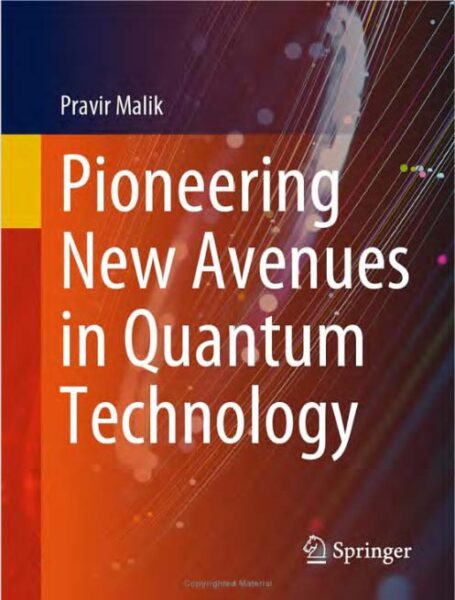
PM: Because I submitted it to a mainstream technical conference, full of professors from engineering departments. I assumed they’d dismiss it as too unconventional. But its acceptance in 2018 gave me confidence to keep going. Since then, I’ve written 17 or 18 more technical papers—all drawn from Cosmology of Light, but always expressed in scientific language. Eventually, I received a contract from Springer Nature—a premier academic publisher—to develop a book from that work. I devoted all of last year to it, working full time. That book, Pioneering New Avenues in Quantum Technology, was released in May 2025.
It presents a radical rethinking of quantum mechanics. At its core, the book argues that today’s quantum physics paradigm is built on a narrow sliver of potential—one that barely scratches the surface of what’s truly possible. To glimpse the broader landscape, I turn to a recurring fourfold structure evident across levels of reality: the Standard Model at the level of quantum particles, the Periodic Table at the level of atoms, and the architecture of molecular plans within cells. I suggest that these are not isolated, unrelated constructs but expressions of deeper symmetries arising from the quantum layer itself. The fourfold structure serves as signatures—hints of the richer functional architecture latent within the quantum substrate.
So in the new book, I use thought experiments as launching points—then quickly translate those into mathematical spaces. These aren’t metaphors. They are models that, if applied, can yield better predictions than current formulations in certain cases. I don’t make overt spiritual references in the book. I stay within the conventions of scientific discourse. But what’s driving it—what’s truly animating it—is the very vision you articulated: that transformation is possible, even at the level of matter. And that reality isn’t fixed—it’s waiting for a different kind of consciousness to engage with it.
JRC: I wonder if you’d go into a bit more detail. When you talk about doing a thought experiment and then translating it into math—that part I don’t fully understand. I’m not fluent in mathematics.
Initiation: Abstraction to Articulation
PM: About a decade ago, I had an encounter with a man who described himself as a closet mathematician. He had read some of my earlier blogs—written more than a decade prior—and invited me to dinner at a quiet restaurant in Berkeley, saying he knew I would understand what he wished to share. The restaurant was candlelit, its paper tablecloths inviting improvisation. Soon after we sat down, he pulled out a pen and began sketching mathematical equations—like whispers or sketches, really—describing dynamics of the universe. He used the tablecloth as canvas, tracing symbols with a quiet reverence. I listened intently, absorbing not only what he said, but something deeper that seemed to pass through the equations themselves. The dinner lasted a couple of hours. In the surreal light, as he continued to write, I drifted in and out of a subtle trance. The boundary between mind and matter, symbol and reality, began to blur.
The next morning, I awoke with an unusual urgency—to express the world mathematically. It felt as though the previous night had been an initiation of sorts. Over the next ninety days, I created a stream of videos, attempting to translate the fractal theories I had once written into my own emerging mathematical language. It was as if a tap had been opened. The outpouring was relentless—so much so that, eventually, I had to pray for it to stop. It was beginning to consume me.
Still, that moment marked a profound shift. I had begun to see mathematics not as abstraction, but as articulation—as a way to capture essence and energy. In The Cosmology of Light, mathematics became the language through which I sought to convey the power and intelligence of light. My formal training in math was limited, but over time, my fluency grew. When I couldn’t find existing symbols to express what I saw, I invented my own. That creative necessity brought its own kind of fulfillment. And later, as I moved to translate light into existing quantum frameworks, this early exploration became an invaluable foundation.
In my work, I have used mathematics to represent both properties and functions. In The Cosmology of Light, each “surfacing” at the physical level—whether animate or inanimate, subjective or objective—embodies distinct functions that reflect deeper patterns. Take, for instance, the element silver. It expresses a constellation of functions that hint at its underlying essence. Most prominently, it exhibits extraordinary conductivity, making it vital in electronics, solar cells, and advanced thermal systems. Silver is also highly reactive with light and certain chemicals, forming compounds like silver halides—essential to photography and optical sensing. Its antimicrobial nature—where silver ions disrupt bacterial structures—enables applications in medical dressings, water purification, and self-sterilizing surfaces. Physically, silver is malleable, reflective, and strikingly beautiful, qualities that explain its enduring role in jewelry, coinage, and mirrors. Beyond its scientific roles, silver has long symbolized purity, clarity, and healing across cultures—its material functions resonating with archetypal significance.
What becomes possible, then, is a mathematical representation of these functions—a function-based equation that encapsulates how silver behaves in the world. Such an equation seeks to distill the very essence of silver—its unique functional identity rendered in symbolic form. Hence, ‘extraordinary conductivity’ would be the primary functional variable in such an equation. But there would be several secondary variables to do with its reactivity, antimicrobial nature, malleability, reflectivity, and so on.

The Double-Slit Experiment
JRC: You’re saying that this form of math is a useful—even necessary—way of expressing thought experiments in your rethinking of quantum mechanics? And then that process opens up possibilities that can be tested, such as: Is this thought experiment valid? Do things actually work this way?
PM: Yes, exactly. That’s what I’ve been proposing. In fact, in the new book I’ve tried to make this approach more concrete. Chapter One revisits the classic double-slit experiment—a foundational enigma in physics since the 1800s. I don’t know how much you know about the double-slit experiment. There’s been a big discussion at different times about the nature of light. People have thought of light as a wave, other times they thought of it as a particle.
JRC: Right. And how can it be both?
PM: Basically here is the double-slit experiment: If you take a source of light, for example, millions of photons at one time, and you send them through two thin slits in a barrier, the photons create an interference pattern on a detection screen behind the barrier. This is similar to the pattern created on a still pond when waves caused by dropping two pebbles into the water collide and interact. So this interference pattern reinforces the wave-like nature of light. However, the paradox is that if you shoot one photon at a time through the barrier slits—so not multiple photons but one photon at a time—there’s no possibility of interference because you don’t have multiple photons. But you still get an interference pattern anyway! Each photon will go through one or the other slit, and yet an interference pattern shows up on the detection screen. And that led to the development of quantum theory and the beginning of thinking about quanta—because the results of the experiment were completely unintuitive.
In quantum mechanics, this enigma has been explained using the principles of superposition and entanglement, which account for why particles exhibit wave-like interference patterns when observed. But I offer an alternative interpretation—one that does not rely on those standard quantum assumptions. Instead, I propose that the behavior observed in the double-split experiment arises from intrinsic properties within light itself. By shifting our perspective about what light is and how it’s structured, we can relate the way photons fall on the detection screen to the inherent characteristics of light—rather than invoking probabilistic abstractions. This leads to the idea of quanta as wholes, suggesting that what we perceive as discrete events—for example, photons arriving one at a time—may in fact be coherent expressions of a deeper, indivisible structure within light.
JRC: This is beautiful. I wonder if you can elaborate just a little more, regarding the patterns on the detection screen and how they represent inherent qualities of light.
PM: In the double-slit experiment we can view the source of light as being an original whole.
JRC: That’s built into your cosmology of light, correct?
PM: Yes, exactly, everything.
JRC: Because you’re starting off with light, which is inherently whole?
PM: The nature of light is a whole, yes. When individual photons fall on the detection screen, though individual, they still express some aspect of the wholeness of their source, light itself. Each photon is light itself and represents in some way the deeper, indivisible structure of light. At the same time the individual photon is “playing a part” in differentiating that original wholeness. Further, math allows the relationship between that individual photon and its indivisible source to be precisely defined, and thereby included in the mathematical expression of the theory. So all the photons that show up on the detection screen together express a whole (the interference pattern) that derives from the source whole (light). In other words, the interference pattern that you see on screen is a derivative whole; in a sense, its context is that full whole from which it started. I propose that the behavior observed in the double-split experiment arises from intrinsic properties within light itself.
JRC: “Differentiating” meaning bringing that wholeness of light into a manifested form of many, moving from the one to the many?
PM: Yes – that is a nice way to think about it.
JRC: So the whole discussion about wave versus particle then becomes irrelevant. Is that right?
PM: No it’s not irrelevant but… We don’t want to get too complicated here. Einstein got his Nobel physics prize for suggesting that when you send light to an atom you need to think about light as particles and not as a wave. This particle-like nature of light is essential to understanding how electrons absorb energy and move to higher energy levels—or even get ejected from atoms. You can’t think of light as a wave in that situation. So the particle aspect never gets minimized or marginalized.
JRC: You’re saying that light, which appears as a wave and is a wave, also takes the form of particle. And its particle nature explains some aspects of electronics and some aspects of physics. But the real point is that the mainstream theories are looking at quantum mechanics in an incomplete way.
PM: Yes, the cosmology of light looks at quantum dynamics in an alternative way. We can definitely leverage even the particle view. That’s what current technology is built on. A lot of the technology is built on looking at light as a particle and understanding how it behaves as a particle.
JRC: Okay.
PM: And that’s generated a bunch of useful technology. My whole point in the book, Pioneering New Aims of Quantum Technology, is that we haven’t adequately looked at that wholeness aspect of light, which would give rise to different kinds of technologies that somehow we’ve minimized over the last 100 years, but that are equally important to look at as well. And so in addition to everything that’s been done, I’m suggesting there’s another way to look at light and build new technologies, if we keep in mind that whole (integral) aspect. And the point of going back to the double-slit experiment was to say that you can interpret it as particle, but you can also interpret it as light being whole. So I use the double-slit as a way to show how if you go back to those fundamentals, and you can begin to see light as a whole, then it should give you an intuitive sense that there’s now a different way to develop technology as well.
Hilbert Space
PM: In Chapter Two of my new book, I introduce a thought experiment. I ask: What if light could travel at infinite speed? What kind of space—what kind of universe—would that create? From there, I derive a mathematical formulation of that conceptual space, using the terminology of quantum theory. This leads to the idea of Hilbert space, which is foundational in quantum mechanics. It’s a kind of mathematical landscape—a conceptual space where quantum states live and evolve.
JRC: That’s not something I’m familiar with.
PM: Hilbert space is essentially a framework—an abstract, multidimensional space—used to model how quantum systems behave. It allows physicists to describe all the possible states a quantum system can occupy and how those states change over time. I first encountered deeper echoes of this through the writings of various Nobel physicists. Some of them emphasized that physical reality can often be understood only by constructing these kinds of conceptual mathematical spaces. So such conceptual spaces aren’t just abstract math—they have been accepted in mainstream physics as a valid way to model physical phenomena.
So in my thought experiments—light traveling infinitely fast, or much faster than the known speed of light—I construct alternate Hilbert spaces to represent what reality might look like under those conditions. Each version has its own internal dynamics.
JRC: I see.
PM: From there, you can use what’s called a wave function—which is like a map of possible outcomes within a Hilbert space. These wave functions help show how something could physically manifest, based on the properties of the underlying space. Currently, we rely on interpretations built around superposition, entanglement, and randomness—often described as a “black box.” You put in something, observe the outcome; but between input and outcome, it’s all a probability cloud. To me, that feels like sweeping the complexity under the carpet.
JRC: We don’t really know how to deal with it, so we just… don’t.
PM: Exactly. So I’m proposing: let’s lift the carpet. Let’s imagine a new structure—rooted in different Hilbert spaces arising from a cosmology of light—and see if that helps us better explain physical phenomena. That’s the core of what I’m trying to do in this book. For instance, when you look at the classification of quantum particles, atomic elements, or molecular structures—even biological cells—there’s an astonishing coherence. If you look deeply, you can begin to see a shared mathematical structure running through all of them. But unless you have a model that shows you those connections, they remain hidden. That’s what I’ve been working on—a model that demonstrates how these seemingly separate layers of reality are actually deeply connected, through the lens of these evolving conceptual spaces. And if that’s true—if this new model really unifies these layers—then it naturally follows that quantum computation should be based on this model. Not just on isolated principles like superposition and entanglement.
New Foundation for Quantum Technology
PM: Instead, the architecture of quantum computers—and how we design them—should draw from this deeper model. One where reality is governed by interconnected layers, each shaped by its own Hilbert-like dynamics rooted in the behavior envisioned in the cosmology of light. That’s been the deeper aim of the book: to propose a new foundation for quantum technology, one that’s aligned with a cosmology in which light is not just a carrier of information, but a shaper of form. And by reframing our equations and our conceptual spaces, we might unlock technologies—and transformations—we haven’t yet imagined.
So yes—in a way, it’s about taking the kind of deep ideas that emanate from Savitri, or from reflecting on the dynamics of light in an expanded cosmology, and asking: What are the practical, material implications of this? How do these insights inform how we need to engineer things—physically—if we want to begin accessing the extraordinary? If we want to actually break the boundaries of what’s considered possible? Because right now, most of what we’re doing—across science and tech—is just reinforcing what we’ve already done. Even quantum computation, as pursued by IBM, Google, or others, is largely focused on speed: taking yesterday’s problems that may take tens of thousands of years to solve and solving them much, much faster. It comes down to being an optimization exercise, not a paradigm shift. But I’m saying that we’re looking at the quantum layer the wrong way.
Threshold between the Invisible and the Visible
PM: The quantum layer isn’t just a more efficient substrate for information processing. It’s a threshold between the invisible and the visible—a seam between realities. And if that’s true, we need an entirely different kind of model to understand how the invisible becomes visible, how the unmanifest precipitates into form. And once we have such a model, that opens the door to a different kind of technology—one that’s not just incrementally better, but radically different. That’s what I’ve tried to develop in this book. The final four chapters, in fact, explore applications—technological hypotheses that can, and should, be tested.
JRC: So those applications would serve as tests of this “code” you’ve been developing?
PM: Yes—exactly. Each application becomes a way to test the model. For instance, one hypothesis I propose is that there’s an infinite source of energy at the quantum level. And I don’t mean that just metaphorically. I believe it’s real, accessible, and—perhaps most intriguingly—organizing in nature: that is, it organizes the very layers of matter and life.
Organizing Layers of Matter and Life
PM: Now, you and I can talk about that energy using the language of Integral Yoga. I see it as correlating with the Mother’s four powers: Presence, Power, Knowledge, and Harmony. These aren’t abstract qualities—they’re forces. Energetic modalities. And I believe they’re traceable, detectable, even instrumentalizable at the quantum level. So we should be able to design instrumentation sensitive enough to detect imbalances in these energies at the nanoscale—right at the quantum threshold. If one of these powers is dominating while the others are suppressed, we may be able to detect that asymmetry in the quantum structure of, say, a biological cell.
And that opens up the possibility for intervention. Let’s say we can measure that distortion. Then, in principle, we can design quantum-level interventions to restore balance among those four energies. If we do that—and if our model is correct—the health of the cell should improve. That’s a testable proposition. And that’s the kind of bridge I’m trying to build—between deeper metaphysical insight and precise technological application. There are a number of such hypotheses in the book. Each one offers a different angle of validation. None of it rests on belief; it’s all about modeling, detection, instrumentation, and empirical feedback. In that sense, Savitri can be thought of as a foundation of blueprints. After all, it is a rich source of patterns and logics that can be reinterpreted in the language of science. And when that reinterpretation is precise—when it’s translated into testable constructs—then different kinds of transformation become not only possible, but observable.
JRC: It’s all really fascinating. It feels like a natural fit for Collaboration.
PM: Thank you.
JRC: I wasn’t involved in crafting the theme for the fall/winter issue of Collaboration—Science, Technology, and Spirituality—but listening to you, I feel like you’re embodying that theme. You’re not just talking about it; you’re doing it.

Validation
JRC: One question—well, I have many—but one I’d like to ask now: Have there been any experiments that validate your formulas, or any parts of your cosmology?
PM: No—not yet. The work is still very recent. From 2017 to 2020, I worked largely in isolation and completed the ten volumes of The Cosmology of Light. That’s where I brought together an interpretation of science and an interpretation of Savitri—and expressed that synthesis in mathematical terms. At the same time, but much more vigorously in 2021 and 2022, I began submitting papers to IEEE conferences. IEEE—the Institute of Electrical and Electronics Engineers—is one of the most respected professional organizations in the world for engineers and technologists. I thought: If I can get this work peer-reviewed via IEEE conferences, that’ll be a good benchmark. And it was encouraging—I had about 10 or 11 technical papers published, all grounded in The Cosmology of Light.
Then I shifted focus again. I wanted to communicate these ideas to a broader audience. So I started writing for Forbes, translating these more technical concepts into business-oriented, thousand-word articles. I published around 18 articles there, all focused on rethinking quantum computation from this expanded perspective. In late 2023, I decided to also publish technical articles via Springer Nature conferences – another highly respected academic publishing channel. Subsequently the goal was to take all the technically vetted IEEE and Springer Nature articles, and deepen them further in a book-length form. That’s what led to Pioneering New Avenues in Quantum Technology, which I completed over the course of 2024. It has just come out. And while the work has now passed through multiple peer-reviewed forums and has a certain standing, experimental validation will take time. The proposals are now more concrete—but it’s early days for funding, instrumentation, and execution.
JRC: Sounds like an exciting threshold.
PM: Yes, it could be. I feel like I’ve just closed a chapter. But what opens next—I really don’t know. Let’s see.
JRC: I’m curious: what kind of feedback have you received through the peer review process? What are reviewers saying?
PM: It’s been mixed. For a paper to be accepted, you typically need two out of three reviewers to sign off. And with my submissions, it’s almost always been split: two reviewers who are enthusiastic, and one who’s pretty much dismissive—without calling it nonsense, basically. But the papers got through. The majority always said: “Even if I don’t agree, this is worth publishing. It’s interesting. It opens a line of thought people should hear.” That’s been a consistent theme.
What’s also been affirming is that along the way I’ve received several awards—mostly at IEEE and Springer Nature conferences. I’ve received maybe seven or eight Best Presenter awards over the last few years, and two Best Paper awards.
JRC: And those are for presentations you’ve given in person?
PM: Yes—oral presentations. The Best Presenter awards are based on live delivery and usually given for each separate technical track in a conference. The Best Paper awards are harder to get. You need a perfect review score—say 5/5 across all categories. If multiple papers achieve that, they all win. I’ve had two of those in the last five years.
JRC: Did that experience tell you anything? I imagine when you’re publishing this kind of work, you’re hoping to find out if anyone else resonates—if anyone out there sees what you’re seeing.
PM: Absolutely. And yes—I’ve found that there’s a real appetite for something different. These papers don’t sound like typical conference submissions, and that alone gets people’s attention. In the last year alone, I’ve presented at Imperial College London, UC Berkeley, Cornell, IBM’s Research Center… These are reputable institutions, hosting established conferences. The response is always mixed. There are people who come up afterward and say, “That was fascinating. I’ve never heard anything like it. What are you planning to do next?” They’re genuinely intrigued. And then, of course, there are others who won’t even look me in the eye. That’s just how it goes. You start to sense where people are open—and where they’re not. You look for the openings.
One moment that stands out: In February last year, I presented at a Springer Nature conference in London. I reached out in advance and said, “Look, I’m flying in from San Francisco. Please don’t give me a side room. I want to speak in the main hall, and I’d like a bit more time.” They agreed, even though I wasn’t a keynote. So I spoke in the main session, with maybe 120 people in the audience—all academics. The Executive Director of Springer Nature’s research division was there too. After the talk, there were a lot of questions. One person in the audience said, You’re talking about God. And I paused for a moment and replied, I don’t know if I’m talking about God—but I am talking about light traveling at infinite speed. And if such light exists, it would contain infinite information, and with that, infinite capacity. There were some really interesting conversations after that talk. But to get to the heart of it: I ended up speaking with the Executive Director of Springer Nature’s research division. I told him directly, I want to do a book with you. That’s how the process began—through that chance meeting. Of course, I had to submit a formal proposal and go through the standard channels, but if he hadn’t been in the audience, and if I hadn’t presented in person, I doubt it would have happened. So you start to realize that showing up matters. Presence opens doors. And part of the journey is also learning to read—who’s open, who’s not, who might be supportive, and who may never be.
Your Journey
JRC: What an extraordinary journey you’ve been on.
PM: Thank you.
JRC: Don’t you think it’s unique? I mean, yes, everyone’s journey is unique—but yours seems to have played out in a particular kind of visibility, across a specific set of domains and institutions.
PM: Yes, I do. And I’ve really loved it. It’s been full of surprises. Nothing about it was predictable.
JRC: [laughs] I don’t know… I suspect you’re a kind of agent—or a spy—from the Eternal.
PM: [laughs] If only! I’d be honored—but I can’t comment on that.
JRC: Well, in any case, much of what you’ve shared feels perfectly suited for Collaboration. And it’s a different kind of audience from what you’re used to. It’s been really moving to hear your reflections on the journey—at least the parts that can be said. I imagine there are dimensions of it that defy words. When I first started reading the Cosmology of Light—the shorter book—I couldn’t get past the first couple of pages. You were talking about the speed of light, and then suddenly about light going faster than light. I thought, Wait… what? It just didn’t compute for me at first. But then I read some of your other writings where you mentioned that these were thought experiments—and that opened the door. Later, I picked up Connecting Inner Power with Global Change, and that one was easier for me to enter.
Four Qualities
JRC: There’s one question that’s been lingering with me—if you have time.
PM: Absolutely, go ahead.
JRC: When you talk about cosmology of light, and then the four qualities—Presence, Power, Knowledge, Harmony—showing up across different levels of matter… subatomic, atomic, molecular, and so on… the way you describe it in your writing—I have to admit—it hasn’t quite made sense to me. You refer to “shells” at various levels, but I didn’t really know what that meant.
PM: Let me try to unpack it more simply. The term “shell” actually comes from standard chemistry—it’s a way of categorizing atoms based on their electron configurations. But rather than getting stuck in technical language, let’s just call them groups. If you look at the periodic table, it’s organized into four main groups: S, P, D, and F. These are well-defined groupings in chemistry. Every element—of the 118 known so far—belongs to one of those four. Now, what I started to ask was: Is there a unifying pattern or functional signature that distinguishes these groups—not just chemically, but energetically, or even archetypally? And what I observed was that each group seems to reflect one of the four core qualities: Power, Presence, Knowledge, or Harmony.
JRC: Okay…
PM: Take the s-block elements, for example. This group includes hydrogen and helium—key players in stellar nuclear fusion, the process that powers stars. The other s-block elements, such as lithium, sodium, and potassium, are among the most chemically reactive, often releasing significant energy in their reactions. I interpret this group as embodying Power—a primal, initiating force expressed through both nuclear fusion and chemical reactivity. Then there’s the F-group, which includes the largest atoms—complex, heavy, and rare. Their atomic structures reflect collectivity—many components functioning together. I see that as an expression of Harmony. The P-group is where you find many of the elemental archetypes—oxygen, nitrogen, carbon. They anchor biological life. I interpret this group as holding Knowledge—the blueprinting or coding function. And finally, the D-group consists of transition metals— often used in construction, machinery, industrial systems. Their role is infrastructural, supporting form and stability. I see that as an expression of Presence—like proteins in a biological cell.
JRC: That’s helpful. Thank you.
PM: Of course. What I’m proposing is that each group seems to derive its dominant function from one of the four qualities—but every element still carries a unique blend. That’s what makes them distinct. For instance, hydrogen and helium are both in the S-group, so they share the core of Power. But each also embodies varying degrees of the other three qualities—Presence, Knowledge, and Harmony. That’s what gives rise to their uniqueness—just as individuals carry a core orientation but express a blend of energies.
JRC: How did you come to see this in the periodic table?
PM: Interestingly, I wasn’t looking for it. It just came to me—spontaneously. The first time this happened, I was reading a book to support my wife Chitvan’s work. Her field is cellular health—she uses non-invasive methods, including electromagnetic frequencies—a form of light, to support healing at the cellular level. So I was reading a detailed book about the cellular structure—to get more involved in her work. I got absorbed in this exploration of what animates a living cell: proteins, nucleic acids, lipids, polysaccharides. I then went for a hike in Tilden Park—it’s a place I often walk, just a few minutes from my house. I was surrounded by plants and trees, and I started reflecting on the macromolecules inside those living forms. And suddenly—it just came. I saw that those four macromolecules weren’t just biological units—they were direct reflections of those same four fundamental energies.
JRC: You mean Presence, Power, Knowledge, Harmony?
PM: Exactly. Proteins, which provide structural support and enable cellular function, aligned with Presence. Polysaccharides, which are about stored energy and rapid release—Power. Nucleic acids, which carry genetic information—clearly Knowledge. And lipids, which form membranes and facilitate integration—Harmony. It was so clear. It wasn’t something I deduced—it came as a direct insight. And once I saw that, I wondered if the same pattern showed up elsewhere. So I turned to the periodic table. Sure enough, I saw those same fourfold groupings—S, P, D, F—and the same kind of energetic correlation emerged. And later, when I examined the Standard Model in particle physics—quarks, leptons, bosons, the Higgs-boson—I saw the same fourfold logic emerge again.
Coherent Emergence
PM: So it wasn’t a theory I constructed and proved. It was a pattern I encountered, and then began to explore more formally.
JRC: That’s extraordinary.
PM: Thank you. From there, I began building a mathematical framework to express it. I designed sets—one for each quality: Presence, Power, Knowledge, Harmony—and looked at how combinations of those sets could model different entities at different scales: atoms, molecules, even cells. And what I found is that you can represent the uniqueness of any structure—whether an element like silver or a cell type—through the balance and interaction of those four core energies. Just as individuals have a dominant soul quality with many layered traits, so too do material forms. It gave me a way to think about functionality in the universe not as random, but as a coherent emergence of deep, patterned intelligence.
JRC: Were the four qualities—Presence, Power, Knowledge, and Harmony—part of your cosmology of light before you had this realization? There have been moments—spontaneous, unplanned—where I’ve felt a deep intimacy with light. Not mentally. Just… experientially. Those moments left a kind of imprint in me, a resonance.
PM: Yes, they were. It’s all deeply connected, though I can’t say exactly in what order it all emerged. As I was thinking about light—its nature, its behavior—these insights began to surface. I’ve also had some spontaneous experiences with light, but I hesitate to talk about those publicly—not because they aren’t meaningful, but because the ideas I’m sharing can be explained entirely through a coherent structure of thought. I don’t want to confuse people or distract from that logic.
Intimacy with Light
JRC: Why wouldn’t those experiences be relevant?
PM: They are, in a way. There have been moments—spontaneous, unplanned—where I’ve felt a deep intimacy with light. Not mentally. Just… experientially. Those moments left a kind of imprint in me, a resonance. So when I began exploring the behavior of light—especially the idea of light traveling at different speeds—it wasn’t just a theoretical or cognitive inquiry. There was something more relational happening.
Of course in its core essence Sri Aurobindo’s Savitri is a cosmology of light. It is about the incredible cosmic journey from darkness to light, and I’ll just say that studying that daily over decades naturally also opens one to the deeper nature of light. And that’s where it became evident that if light were traveling infinitely fast, it would be all-present, touching all points simultaneously. If anything arose or vanished within it, it would inherently “know”—so there’s an intrinsic knowledge. And if anything opposed its nature, it would be overpowered—so light also has supreme power. And finally, because everything would exist within the field of that all-present light, there would be an underlying harmony. And then, through the idea of quantization—which for me is essentially what happens when light slows down—those qualities begin to differentiate. Because when light is moving at infinite speed, everything in it is unified, indistinguishable. But as it slows, its inner content becomes more visible. Differentiation begins. And in that differentiation, you can start to perceive the structure, the seeds of form.
JRC: So you’re saying we begin to see the substance, or manifestation, of the Infinite?
PM: Yes. Slowing light down allows that unseeable infinity to reveal something of itself. That’s the heart of quantization. It’s not just about energy levels—it’s about the process through which the subtle becomes manifest, how the invisible becomes visible. So in the mathematical model I developed, there are four core properties when light is traveling at infinite speed. These are the source qualities. But as light slows—through quantization—those four become increasingly differentiated. Presence, for example, unfolds into a vast set of “presences.” Each one a distinct expression of that original source. In other words, those original source qualities now appear as large mathematical sets, each filled with infinite variation. They form the substance from which all differentiated structures emerge.
JRC: And if light slows even further?
PM: Then there is even further differentiation due to unique combinations of the elements from the four sets. These unique configurations can be thought of as quantum seeds. These are the foundational differentiations—what I call the “seeds” of form—that precede material manifestation. From these quantum seeds, space itself emerges. So the model is: light begins in infinite speed* undivided. As it slows, it undergoes quantization. That quantization results in structured differentiation—first into sets, then into unique combinations of those sets, which then become the basis of material reality. It’s both a cosmology and a mathematics. A way of imagining—and structuring—how the invisible becomes visible, how energy becomes form, how light becomes matter.
JRC: I’m going into trance as you’re talking.
PM: [laughs softly] It’s a kind of map, in a way.
JRC: Let me try to reflect back what I’m hearing—see if it resonates: You’ve had experiences—intimacies—with light: perhaps brought about by your study of Savitri. And though “intimacy” is just a placeholder, a word for something that probably defies words, that experience drew you in. Not as an abstract idea, but as a real, living presence. And as you moved deeper into that relationship with light—it began to show itself, or you began to perceive its self-differentiation—and that’s when the insights began to emerge.
PM: Yes. It’s like a residue from those moments—a kind of imprint that remains. And through that residue, there’s now a way—however approximate—to sense into the nature of light. That approximation becomes a pathway. You begin to see how everything that manifests materially is somehow an expression of these dynamics of light. That’s really why I call it Cosmology of Light—because everything that arises is, in some sense, a way light is revealing its infinite potential. It’s expressing itself endlessly. And the mathematics I’ve developed—it’s like a lens. It’s not “the truth,” but it gives you a glimpse into how that infinity is materializing. How the subtle differentiates into the visible.
JRC: That was beautiful. I’m so glad I asked. There was a gap in my understanding before—a disconnect in the words. “Imagine light traveling at infinite speed,” “it fills the volume,” “it has symmetry”—all those phrases left me hovering at the surface. But what you just shared made it land.
PM: Thank you for asking, John Robert.
Conclusion
In closing, what emerges is not just a new framework for quantum computation or cosmological modeling, but a deeper call—to look again at the structures we take as fixed, and see how they can instead be malleable expressions of evolving consciousness. From the poetic metaphysics of Savitri to the mathematical formalism of Hilbert spaces, this conversation invites us to consider that the universe is not a finished artifact but a dynamic unfolding. And within that unfolding lies the possibility that technology, biology, and consciousness itself may be shaped by a deeper organizing light—one that is at once scientific and sacred, intimate and infinite.
Dr. Pravir Malik, founder of QIQuantum, pioneers fractal models linking quantum dynamics to complex systems, advancing orthogonal pathways in quantum computing.
John Robert Cornell is an editor of Collaboration and a member of the Sri Aurobindo Association board of directors.
- 1. Sri Aurobindo, Savitri, Complete Works of Sri Aurobindo (CWSA), vols. 33–34 (Pondicherry: Sri Aurobindo Ashram Trust, 1997), p. 307.
- 2. https://books.google.com/books?id=xJOHAwAAQBAJ&newbks=0&hl=en&source=newbks_fb
- 3. Sri Aurobindo, Savitri, pp. 98–99.
- * SAGE Publications, located in Thousand Oaks, CA; New Delhi, India; London, England; and Singapore.
- 4. For the Cosmology of Light, see https://pravirmalik.medium.com/index-to-cosmology-of-light-links-d155ea46bf5a
- 5. See The Mother, Mother’s Agenda 1962, vol. 3 (https://incarnateword.in/agenda/3/july-14-1962#fnref4) pp. 258–259, including footnote 4 on p. 258.
- 6. Malik, P., Pioneering New Avenues in Quantum Technology 1st ed.. (Springer Nature Singapore, 2025). https://doi.org/10.1007/978-981-96-5463-5
- 7. Malik, P., “The Role of a Light-Based Quantum Computational Model in the Creation of an Oscillating Universe,” 2022 IEEE 12th Annual Computing and Communication Workshop and Conference (CCWC), Las Vegas, NV, USA, 2022, pp. 0953-0959, doi: 10.1109/CCWC54503.2022.9720904. keywords: {Adaptation models;Quantum computing;Quantization (signal);Adaptive systems;Conferences;Computational modeling; Genetics;Quantum Computation;Cosmic Expansion-Contraction; Genetics;Symmetrical Model of Light;Complex Adaptive System}
- * The Institute of Electrical and Electronics Engineers
- 8. Sri Aurobindo, The Mother with Letters on the Mother, CWSA, vol. 32 (Pondicherry: Sri Aurobindo Ashram Trust, 2012), pp. 17–23.
- * Infinite speed is part of the thought exercise where the lever is speed. When you adjust the speed of light to the highest it becomes infinite.